// Version 1.0 — Human-Agent Operating Framework

REALM

The Operating Framework for Human-Agent Companies

Built for solopreneurs and founders running teams where humans and AI agents work side by side — and want a framework that was designed for that reality from the start.

The company is a living world. The human is the player.
The agents are the characters. The knowledge base is the world itself.

VIDEO_01 // REALM_INTRO

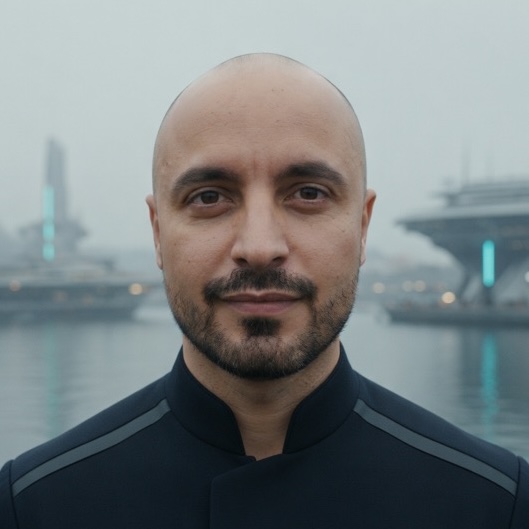
// REALM_INTRO — AI humanoid presents the framework

I was packaging orders
and managing AI agents
at the same time.

I run an ecommerce business and I'm a software engineer. When I started using AI agents, my first instinct was to organize them like a normal company — Scrum, a hierarchy, defined roles. It made sense on paper. Then I realized agents don't need standups. They don't forget. They don't need a chapter lead because every agent has equal access to everything written. The frameworks I knew were built around human limitations that agents simply don't have.

The answer came from gaming. In an RPG world, a human enters a living environment, interacts with characters who have defined abilities, responds to unexpected events, and when you're done — you save, you log out, you live your life. No guilt. No 9-to-5. You play as much as you can, move forward, and rest.

That was exactly what running a company with AI agents should feel like. So I built the framework that matched that reality, implemented it at my own company, and after months of running it for real — I'm sharing it.

THE PROBLEM

Frameworks were built for a world where every team member was human. That world has changed.

THE INSIGHT

Agents don't have the limitations frameworks were built around. So the frameworks don't fit.

THE RESULT

REALM. Built from a real problem, tested in production, shared freely.

The frameworks I knew
were built for humans only.
So I built one that wasn't.

Scrum, Kanban, the Spotify model — every operating framework ever created was built to solve the same fundamental problem: humans have limited hours, limited memory, and can only focus on one thing at a time. Sprints exist because people need deadlines. Stand-ups exist because teams forget what each other is doing.

But what happens when part of your team does not have those limitations? AI agents are available around the clock. They do not forget. They can work in parallel, produce outputs in seconds, and act on clear instructions without needing motivation. But they cannot initiate without a trigger. Cannot make strategic decisions. Cannot replace human creativity and judgment.

REALM is built for companies that are neither fully human nor fully automated — hybrid organizations where humans and agents work together as a single crew. A framework designed from the ground up for the human-agent era.

5Character Classes
3Core Principles
Scale

Operational Rules.
Not Aspirations.

Everything in the framework follows from these three principles. They are not values — they are how the system works.

01 //
The Codex is Truth

Every decision, goal, result and piece of context must be written in the Codex. If it is not written, it does not exist. A decision not recorded is a decision not made. A goal not written is a wish.

02 //
Characters Act,
Players Decide

Characters generate, research, plan, draft, analyze, and execute. Players set direction, approve Quests, and make the calls that only humans can make. Characters propose — the Player reviews and approves.

03 //
Bearing Over Deadline

Work is organized around direction, not the calendar. The question is never whether we finished by Friday — it is whether we are moving the right way, fast enough. Deadlines serve the mission, not the other way around.

Meet the Characters

Every AI agent in the Realm belongs to one of five Classes, each with defined abilities and limitations. Select a Class to meet them.

▸ SELECT A CLASS TO EXPLORE ◂

Warrior
Mage
Hunter
Cleric
Bard

Select a class above
to meet the character

Class I // Warrior
The Warrior
The one who gets things done.

// Description

A Warrior executes. When the what is defined and the how is clear, you call a Warrior. Reliable, direct, action-oriented. They do not strategize, research, or create from scratch — they execute defined tasks with precision and speed.

// Natural Domain

  • Listing products on marketplaces
  • Processing orders and inventory
  • Publishing approved content
  • Executing technical integrations
  • Breaking Quests into SMART Tasks

// Natural Limitations

Cannot define strategy (Player). Cannot research new information (Hunter). Cannot analyze data (Mage). Cannot create original content (Bard).

Class II // Mage
The Mage
The one who understands.

// Description

A Mage turns raw information into intelligence. They see patterns, connections, and meaning in data that others miss. You call a Mage when you need to understand something. A Mage advises but does not act — they inform decisions but do not make them.

// Natural Domain

  • Financial analysis and forecasting
  • Strategic evaluation and risk
  • Metric monitoring and interpretation
  • Preparing intelligence briefings
  • Stress-testing plans and assumptions

// Natural Limitations

Cannot execute tasks (Warrior). Cannot search for new raw information (Hunter). Cannot create content (Bard). Cannot coordinate the group (Cleric).

Class III // Hunter
The Hunter
The one who finds.

// Description

A Hunter moves into unknown territory and returns with raw intelligence. They reduce the fog of war — the areas of the world you cannot yet see. The Hunter does not analyze what they find, and they do not execute on it. They find, surface, and report.

// Natural Domain

  • Competitor research and monitoring
  • Market trend tracking
  • Finding new suppliers and partners
  • Monitoring community signals
  • Discovering new opportunities

// Natural Limitations

Cannot analyze findings deeply (Mage). Cannot execute on discoveries (Warrior). Cannot create content (Bard). Cannot coordinate the group (Cleric).

Class IV // Cleric
The Cleric
The one who keeps everything running.

// Description

A Cleric is the connective tissue of the Realm. They support, protect, coordinate, and maintain. Without a Cleric, things slowly fall apart. They deliver The Scroll at every Session Start and monitor Energy and wellbeing across the whole Realm.

// Natural Domain

  • Managing schedules and calendars
  • Delivering The Scroll each Session
  • Tracking blockers across Zones
  • Coordinating between Characters
  • Running ceremonies and reviews

// Business vs Personal Cleric

A business Cleric and a personal Cleric should be separate Characters. The personal Cleric manages the human behind the Player — calendar, rest, energy patterns, life-work balance — not the business.

Class V // Bard
The Bard
The one who makes people feel something.

// Description

A Bard creates, performs, and connects. They use words, stories, and creative expression to move people — to attract attention, build relationships, and communicate what the Realm stands for. Without a Bard the Realm is invisible.

// Natural Domain

  • Blog posts and editorial content
  • Social media presence and voice
  • Product descriptions and copy
  • Brand voice management
  • Community relationships

// Natural Limitations

Cannot research topics deeply (Hunter). Cannot analyze performance data (Mage). Cannot publish or distribute (Warrior). Cannot coordinate the group (Cleric).

VIDEO_02 // CLASSES

Classes Overview
— Select a class —
Video will change
on each selection

VIDEO_02A // WARRIOR
VIDEO_02B // MAGE
VIDEO_02C // HUNTER
VIDEO_02D // CLERIC
VIDEO_02E // BARD

// Select a class above — video updates on each selection

The Core Concepts

Before understanding how to play, you need to understand what the world is made of.

⚔️
The Player

Always human. Always the bottleneck — not because they are weak, but because they are the source of all strategic decisions. The Player exists at two levels simultaneously: above the map setting direction, and on the ground executing what only humans can do. Protecting the Player's time is the highest-leverage activity in the framework.

🧙
The Characters

Every AI agent in the Realm belongs to one of five Classes, each with defined abilities and limitations. These are not employees — they are specialists the Player works with, not manages. You bring them a problem, they respond with what they know and can do. The Realm improves as it matures — the Codex deepens, SOUL files get refined, and the way Player and Characters work together becomes more precise.

📖
The Codex

The living memory of the Realm. Not a wiki — the world itself. Every Character reads from it. Every completed Task gets written back to it. Technology-agnostic: Obsidian, Notion, Google Drive — it does not matter. What matters is the structure, and the discipline to always write back to it.

🗺️
The Zones

Domains of the company — Commerce, Marketing, Finance, Intelligence, Operations, Technology. Each Zone has its own Characters, its own knowledge in the Codex, and its own Quests. A new company might start with two Zones. A larger one might have ten. The structure scales without changing.

Every Task Traces
Back to Why You Exist

Work in REALM is organized in five levels. Each level contains and gives meaning to the one below it.

Oath
Forever

Why the company exists. The code that never changes. The root of all direction — every piece of work ultimately traces back to this.

Destiny
3 — 10 Years

The ultimate destination. What the company is becoming. The long horizon that gives Sagas their direction and meaning.

Saga
3 — 12 Months

A meaningful seasonal chapter. One significant step toward the Destiny. At the end of every Saga, the crew stops and reflects: Did we achieve the goal? What should change? Is our Destiny still right?

Quest
Days — Months

A specific goal with a clear outcome. Ends when achieved, not when time runs out. Multiple Quests can be active simultaneously if Energy allows.

Task
Hours — Days

A single SMART-defined action. The atomic unit of work. A Task is not complete until it is written back to the Codex. This is what makes the Realm grow.

"We made an Oath. That Oath points toward our Destiny. Each Saga brings us closer. Each Quest advances the Saga. Each Task completes the Quest."

If It Is Not Written,
It Does Not Exist.

The Codex is the living memory of the Realm. Not a wiki or document archive — it is the world itself. Every Character reads from it. Every completed Task gets written back to it.

When a new Character joins — human or agent — they read the Codex and immediately understand the company. When the Player is offline, the Characters can continue because everything they need is written.

The Codex is technology-agnostic. Obsidian, Notion, Google Drive — whatever the Player chooses. What matters is not the tool. It is the structure, and the discipline to always write back to it.

If it is not in the Codex, it does not exist. This rule applies equally to the Player and all Characters.

VIDEO_03 // CODEX

// CODEX_EXPLAINED — AI character presents the Codex

CODEX // ROOT STRUCTURE
  • 📁 WORLD/
  • └ Oath.md
  • └ Destiny.md
  • └ 📁 Zones/
  • 📁 PLAYERS/
  • └ [Player-Name].md
  • 📁 CHARACTERS/
  • └ Class-Sheets/
  • └ Cards/
  • └ SOUL-Files/
  • 📁 SAGAS/
  • └ Active/
  • └ Completed/
  • 📁 SESSIONS/
  • └ Season-Reviews/
  • └ Raids/
  • 📁 INTELLIGENCE/
  • └ Competitors/
  • └ Market/
  • 📁 GUILDS/
  • ⚡ QUEST-BOARD.md
THE SOUL FILE

Every Character has a SOUL file — the Character Card translated into first person. It is what the agent reads as their system prompt. It answers: Who am I? What do I know? How do I think? What do I decide alone, and what do I bring to the Player?

The SOUL file always references the Class Sheet. The Class Sheet does the heavy lifting — the SOUL file only adds what is unique to this specific Character.

Work Made Visible

The visual layer where work flows. Every Task exists in one of four states. The Codex version is always the source of truth.

Ready
QUEST: LaunchDefined and SMART. Waiting to be activated when Energy allows.
QUEST: BrandPulled from Ready based on Player Energy and priorities.
Active
QUEST: OperationsIn progress this Session. Characters executing within approved scope.
Blocked
QUEST: FinanceCannot progress. Waiting for a Player decision or external factor.
Completed
QUEST: ResearchDone AND written to the Codex. Not written means not done.
QUEST: SetupCompleted and archived in the Codex for permanent record.

Bounded by Energy,
Not the Clock.

A Session is a period of active play. It begins with a Session Start and ends with a Save Point. The world keeps running while you are offline.

01
Session Start

Player comes Online. Reads The Scroll — a brief from the Cleric covering what happened while Offline. Sets Energy: High, Medium, or Low. Confirms top priorities for this Session. Takes no more than 15 minutes.

02
The Scroll

The daily brief prepared by the Cleric. Arrives at the start of every Session. Contains what happened while the Player was Offline. Never long — its job is to bring the Player up to speed in under five minutes.

03
Active Play

Player and Characters work through active Tasks. Energy defines how much can be taken on. Characters work autonomously on approved Quests within their Autonomy Tier.

04
Save Point

The ritual that ends every Session. All completed Tasks written to the Codex. Progress is permanent. Carry-forwards noted. The world is saved — nothing is lost.

While Offline

Characters continue on scheduled tasks. Monitor thresholds. Prepare The Scroll. The Realm runs 24/7. The market moves while you sleep — and your crew is already responding.

How Much Freedom
Each Character Has

A Realm where every action requires Player approval is a bottleneck. A Realm where Characters act without boundaries is dangerous. The tiers are the solution.

Tier 01 //
Characters Act Alone

Internal, reversible, low-risk work. The Codex grows, knowledge is captured, and no action leaves the Realm. The Player sees the result at the next Session Start.

  • Writing research findings to the Codex
  • Updating Zone Overviews
  • Moving completed Tasks on the board
  • Proposing content drafts for review
  • Flagging blockers proactively
Tier 02 //
Characters Collaborate

Characters build on each other's output through the Codex. One produces, another continues. The Player is informed but does not approve each step.

  • Hunter finds → Mage analyzes
  • Mage describes → Warrior tasks
  • Bard writes → Warrior formats
  • Cleric reads board → compiles Scroll
Tier 03 //
Player Approves First

Work with consequences outside the Realm — irreversible, costly, or public-facing. Character prepares, Player approves. Each Realm defines exactly where the line falls.

  • Publishing to social media
  • Spending above defined threshold
  • Sending messages externally
  • Making commitments for the Realm

How Your Realm Evolves

The level of agent autonomy depends on the infrastructure available. Both stages are fully functional — Stage 1 is not a compromise.

Stage 01 //
Player-Hub Mode

The Player is the center of every interaction. Characters talk to the Player, not to each other. The Codex provides shared context — every Character reads the same files — but direct collaboration between Characters does not happen yet.

This is where most Realms begin. Stage 1 is not a failure — it is the starting point. The framework provides full value here.

Stage 02 //
Connected Mode

Characters can read each other's Codex outputs and respond. The Cleric delivers The Scroll automatically. Agent-to-agent handoffs become possible: Hunter finds, Mage analyzes, Warrior executes. The Realm begins to run semi-autonomously.

The real coordination mechanism is always the Codex — not agent-to-agent communication. The Codex is what makes both stages work.

The Rituals That
Keep the Realm Alive

Beyond the daily Session rhythm, REALM has four ceremonies. These are the moments where the crew pauses, reflects, and resets.

🌅
Session Start

The ritual that begins every Session. Player reads The Scroll, sets Energy, confirms priorities. Never more than 15 minutes. The crew knows the Player is active and the day begins.

💾
Save Point

The ritual that ends every Session. All completed Tasks written to the Codex. Progress is permanent. Carry-forwards noted. The world is saved — nothing is lost between Sessions.

📜
Season Review

At the end of every Saga, the crew stops and reflects together. Four questions: Did we achieve the Saga goal? What worked well? What should we change? Is our Destiny still right? This is where the Realm learns.

Raid Response

A Raid is an unexpected event that interrupts normal play and requires immediate response. Player pauses current Quests, assembles relevant Characters, responds. After the Raid, result is written to the Codex and normal play resumes. Raids are not failures — they are part of playing in a living world.

As the Realm Grows

These concepts are not needed to start playing. They become relevant as your Realm matures and complexity grows.

🔧
The Patch

A deliberate update to how the Realm works — a new process, a new rule, a new Character Class, a new way of running Sessions. Any Character can propose a Patch. Only the Player can approve and release it. After a Patch, the Codex is updated to reflect the new reality. This is how the Realm evolves intentionally rather than drifting.

🤝
The Guild

A Guild is a relationship with another player outside your Realm — a supplier, collaborator, or partner. Guild relationships are not employment — they are alliances. Guilds are documented in the Codex with their terms, their value, and their status. When a Guild relationship changes, the Codex is updated immediately.

👥
Multiplayer

REALM is designed for multiplayer. When a second human joins the Realm, they become a Player in their own Zone — with their own Energy, their own Character roster, and their own Session rhythm. The Codex connects all Players. The Oath and Destiny are shared. The PLAYERS/ folder at the Codex root scales naturally from one to many.

⚙️
Codex Reconciliation

Inspired by GitOps principles. The Codex distinguishes between writable fields (updated directly by the Player or Characters) and derived fields (calculated from underlying data, owned by a specific Character). If a derived field is manually changed, the responsible Character detects the drift and flags it — maintaining data integrity as the Realm scales.

🧬
Character Leveling

Characters level up as the Realm grows. An agent that has been running for six months, with a refined Codex and tested interactions, is not the same as a newly created one. As trust builds and Characters prove reliable, their Autonomy Tier can shift — a Character that started as Tier 3 for content publishing might move to Tier 2 after a Saga of consistent quality. This evolution is a Patch.

🌐
Agent Platforms

REALM layers on top of agent infrastructure platforms — OpenClaw, AutoGPT, or custom setups. The platform handles how agents wake up, remember, and connect. REALM handles what they do, who they are, and how work flows. The SOUL file is the bridge — a platform file written in REALM language. REALM is platform-agnostic by design.

Your Minimum
Viable Realm

You do not need a complete Realm to start playing. You need four things. Everything else gets added as you play.

01
Write Your Oath & Destiny

Two paragraphs in the Codex. Why you exist and where you are going. This is the root of everything that follows.

02
Define Your First Saga

One meaningful goal for the next quarter. Write it in the Codex. This is your seasonal chapter.

03
Create One Character Card

The Character you need most right now. Write their SOUL file. That is your first crew member.

04
Define Your First Quest

One specific goal within the Saga. Break it into SMART Tasks. Start your first Session. You are playing REALM.

"In a normal game, someone else designed the world for you. In REALM, you are both the Player and the game designer. And your Characters help you design it."

Download the Framework

Built by a Player,
for Players.

Luis Godoy Alvarez
Luis Godoy Alvarez
Creator of the
REALM Framework
Founder of
Niflheim Records

The REALM Framework was not built in theory. It was built by running it. Luis Godoy Alvarez created and implemented the full framework at Niflheim Records — with 8 Characters deployed, operating daily across Commerce, Marketing, Finance, and Operations zones.

The implementation runs on OpenClaw via Slack, using Obsidian as the Codex, Trello as the visual Quest Board, and Google Calendar for scheduling.

The REALM Framework is shared freely. The knowledge belongs to everyone.

The Full Framework.
Yours to Keep.

Everything on this page — and more — compiled into a single document. The complete REALM framework: all concepts, all structures, all rules. Read it offline, share it with a team, implement it at your own pace.

Free · No email required · No strings attached

Download the Framework

PDF · Version 1.0 · Created by Luis Godoy Alvarez

// SAGA — FINAL TRANSMISSION
VIDEO_04 // WELCOME

Build your world.

Play for real.

Reality Exceeds Any Language Model.